Essay
The Paycheck Bitcoin Never Had
Why we believe in STRC and bitcoin-backed digital credit, and the hard questions we asked before saying so.
By the Coinage team · October 27, 2026
Update, October 28, 2026: Strategy’s shareholders approved daily STRC dividends, with 99.3% of votes cast in favor. The first daily dividend goes to holders of record on November 1, paid November 2, at 12% a year. From then on, every calendar day earns a dividend, weekends included, each paid the next business day.
Why we’re writing this
We believe bitcoin is the best long-term savings technology ever built. It has one flaw for regular people: it never pays you. STRC is the first product we’ve seen that fixes this at scale. This post explains why we believe in it, and the hard questions we asked before saying so.
Start with the problem. The average US savings account pays 0.37% a year. At the biggest banks it’s often 0.01%. Leave $10,000 in a big-bank savings account for a year and you earn about $1.
Bitcoin holders have the opposite problem. Their asset can grow, but it pays nothing along the way. To spend it, you sell it. And selling the thing you believe in to pay rent never feels right.
In July 2025, Strategy, the company led by Michael Saylor, launched STRC. Today it pays 12% a year, trades near $100 a share, and has $8.6B outstanding. Strategy says about 80% of it is owned by regular people, not institutions.
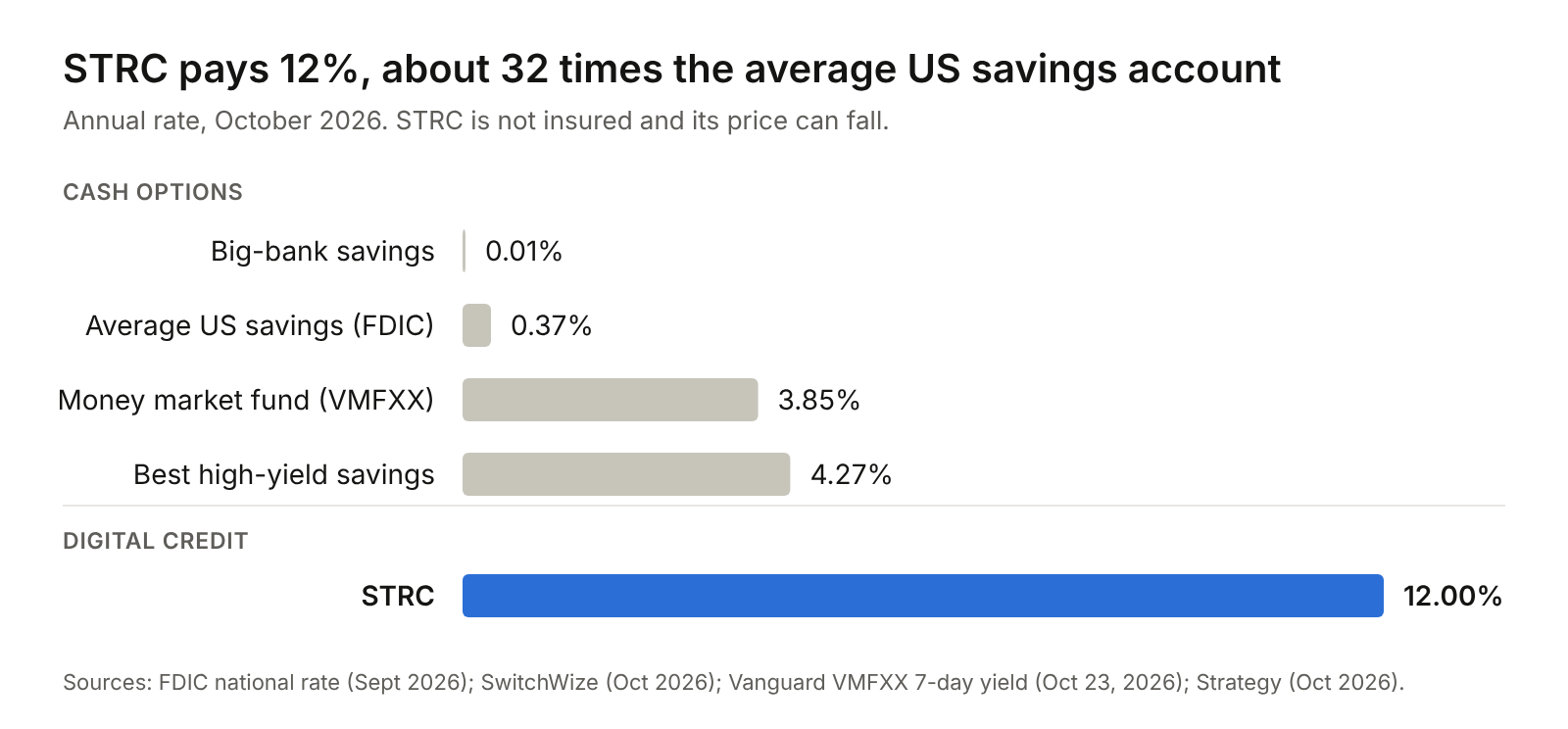
We’re Coinage. We build an app that helps people own assets instead of letting dollars sit idle. Before writing this, we went through the filings, the crash and the critics. We came out more convinced, not less. Every number in this post has a source, and you’ll find them all at the end.
Bitcoin: the base layer
Everything in this post rests on one belief: bitcoin keeps getting scarcer while more of the world wants to own it.
The supply is almost done. The 20 millionth bitcoin was mined on March 9, 2026. Fewer than 1 million remain, and the network will release them over roughly the next 114 years. No central bank, company or government can print more.
Wall Street became a holder. US spot bitcoin ETFs turned 1,000 days old on October 8, 2026. Together they hold about 1.29 million bitcoin, worth about $107B. That’s more than the 1.1 million coins attributed to Satoshi Nakamoto. BlackRock’s IBIT alone holds about 806,000, and it was the fastest ETF in history to reach $50B.
Companies became holders too. In all, 173 public companies now hold 1.3 million bitcoin, about 6% of all the bitcoin that will ever exist. In the first quarter of 2026, companies bought about 2.8 times as much bitcoin as miners produced.
Put those together and ETFs and public companies hold about 2.6 million bitcoin. That’s roughly one of every eight that will ever exist, before counting private funds, governments and the coins lost forever.
We’re writing this in a down year, on purpose. Bitcoin traded near $82,000 on October 20, about 35% below its October 2025 record of $126,198. Even so, over the ETFs’ first 1,000 days, bitcoin rose 93%. It has fallen more than 70% four times in its history, and it reached a new high after every one.
We think the next decade belongs to the asset with a fixed supply and growing demand. That’s our bet. This post answers a different question: how do you get paid while you wait?
An old idea in new clothes
Digital credit sounds new. The idea underneath it is 236 years old.
In December 1790, Alexander Hamilton sent Congress his plan for a national bank. Gold and silver used only to pay for things, he wrote, had been called “dead stock.” Put to work through sound banks, they “acquire life, or, in other words, an active and productive quality.”
Earlier that same year, in his Report on Public Credit, he made a bolder claim. Debt that is properly funded and trusted “answers most of the purposes of money.” He added one rule: every debt should come with the means to pay it off. He called that “the true secret for rendering public credit immortal.”
Bitcoin is today’s dead stock. It’s the hardest money ever made, and most of it just sits. Digital credit is Hamilton’s move applied to bitcoin: take capital people trust, fund it properly, and turn it into something that pays.
In 1970, nearly two centuries after Hamilton, the economist Fischer Black imagined a world where “money in the usual sense would not exist.” Black later co-created the Black-Scholes model. In his imagined world, every balance would simply earn what the assets behind it earn. His biographer, Perry Mehrling, has argued that Black’s 1970 dream is now our reality.
Michael Saylor describes the new system in three layers. Bitcoin is digital capital: scarce, long-term and bumpy. MSTR, Strategy’s common stock, is digital equity: amplified bitcoin. STRC is digital credit: a steady income built on top of that capital. On top of credit, he expects a new layer of apps that bring digital money and yield to everyday people.
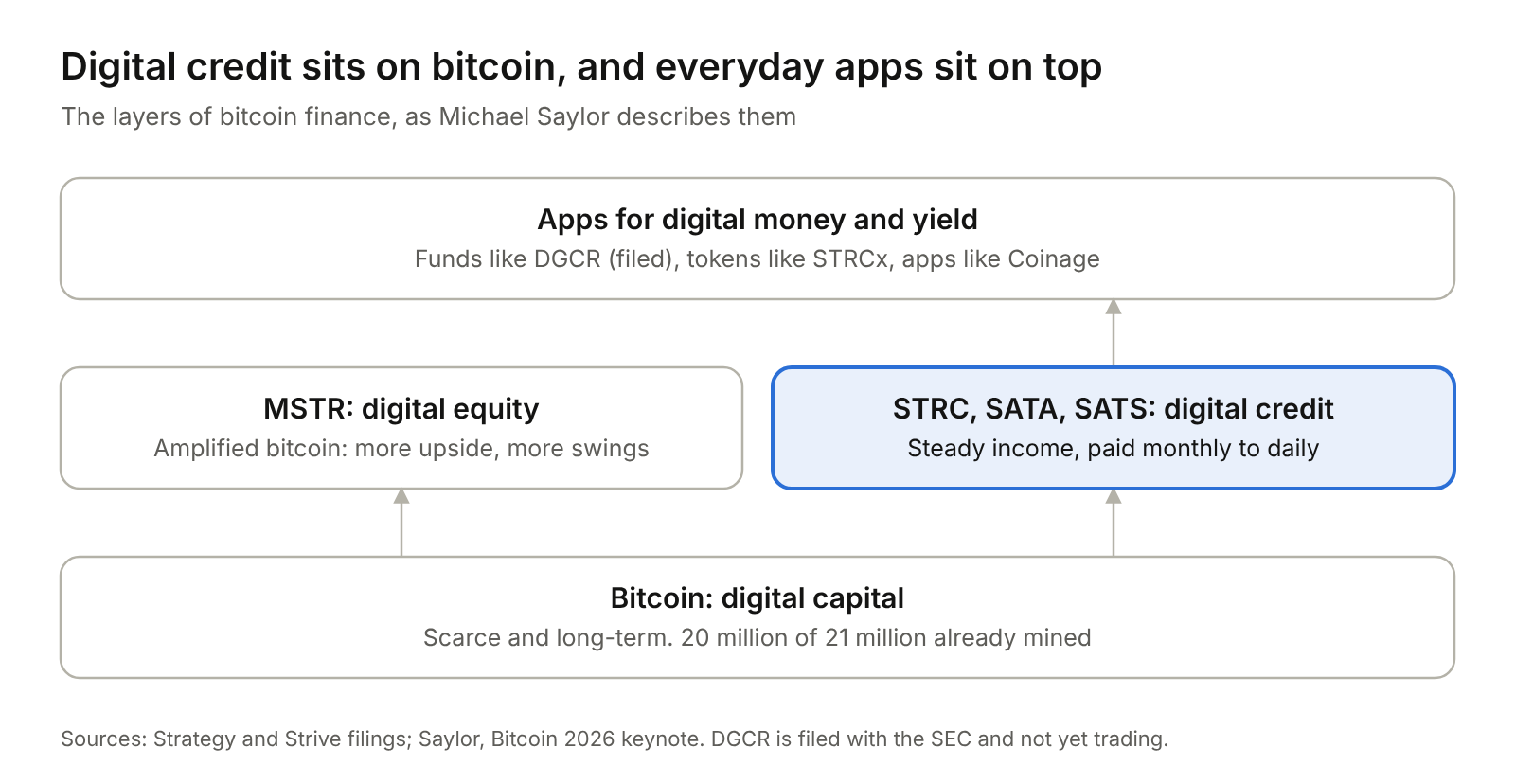
The simple version goes like this. You buy STRC, and Strategy uses the money to buy bitcoin. Strategy pays you a dividend, twice a month today and soon daily. Your claim ranks ahead of MSTR shareholders. That’s Hamilton’s funded debt, with bitcoin as the treasury.
How STRC works
STRC is a share of Strategy preferred stock. It pays a cash dividend, aims to trade near $100, and lets Strategy adjust the rate each month. Five rules matter.
- $100 a share, forever. STRC never matures. The dividend is calculated on its $100 stated amount.
- The rate moves, mostly up. Strategy can raise the rate by any amount. Cuts are capped at 0.25 points a month, plus any drop in short-term rates. The rate can never fall below one-month SOFR, a benchmark short-term rate, and no cut is allowed while dividends are owed.
- Missed dividends pile up. Dividends are cumulative. If Strategy ever skipped one, it would still owe it, with interest, before common shareholders get anything.
- It stands high in line. STRC ranks behind Strategy’s debt and its STRF preferred stock. It ranks ahead of STRK, STRD, STRE and MSTR common stock.
- Strategy can buy it back at $101. That caps the upside on price. STRC is built for income, not price gains.
STRC paid monthly at launch and has paid twice a month since July 2026. If holders approve on October 28, it pays every day starting November 1.
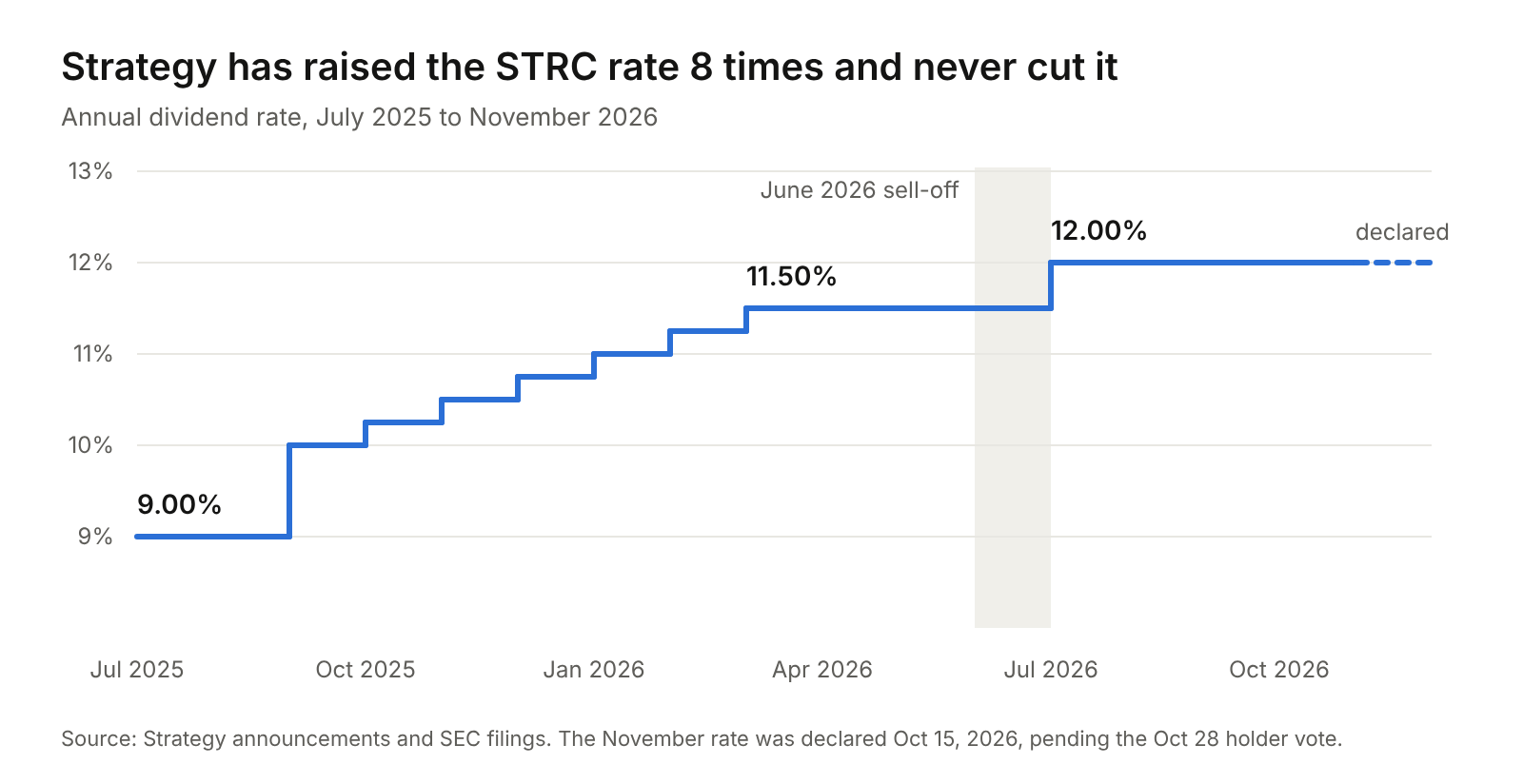
Some people read the hikes as a sign of stress. We read them as the design working: when demand dipped, holders got paid more. Strategy says it will hold the rate at 12% until STRC shows steady trading near $100.
Seven reasons we’re bullish on STRC
1. It grew faster than almost anything in finance
STRC raised $5B in its first seven months. Strategy CEO Phong Le called it the company’s “iPhone moment” and said only BlackRock’s bitcoin ETF grew faster. By early May 2026, STRC had raised $5.58B in that year alone.
2. It’s the most traded preferred stock in the world
In April, STRC’s average daily trading was about 23 times that of the next-largest preferred stock. That liquidity means you can get in and out without moving the price much.
3. The bitcoin cushion is large
As of October 25, Strategy held 848,517 bitcoin, bought for $64.02B. STRC’s notional value is $8.6B. Strategy’s own “BTC Rating” puts its bitcoin at 6.2 times the value of STRC plus everything ranked ahead of it. Bitcoin would need to fall to $13,336 before those holdings only matched those claims. That’s Strategy’s own measure, not an agency rating, but the math is public and updates live on its website.
4. There are real dollars in the bank
Strategy holds a $4.83B dollar reserve set aside for dividends and interest, plus $242M in other cash. Saylor says that covers about 3.5 years of dividends. Hamilton would approve: debt that comes with the means to pay it.
5. It’s calm by design
STRC’s 30-day volatility is 9.8%. In early October, Saylor pointed out that it had dipped below the volatility of the biggest S&P 500 ETF. His argument is that STRC belongs in the income part of a portfolio, not the crypto part.
6. It pays more often than your bank
STRC pays twice a month today. If holders approve on October 28, it pays every day from November 1, weekends included. Strategy also expects 2026 dividends to count as a return of capital, which pushes the tax bill to when you sell.
7. It’s good for bitcoin itself
Every STRC dollar becomes bitcoin demand. By late April 2026, STRC had funded about 77,000 bitcoin that year. Saylor’s bet is that digital credit pulls money out of old credit markets and into bitcoin for years. If he’s right, STRC holders are funding the very asset that protects them.
The stress test
Every credit product looks safe until it’s tested. STRC got its test in June 2026. It passed the part that matters most to an income investor: the dividends kept coming.
In mid-May, STRC sat at $100 with bitcoin above $80,000. Late that month bitcoin slid, and STRC broke below $100. Strategy sold 32 bitcoin to help fund dividends, its first sale since 2022. On June 18, STRC hit a record low of $82.53, and Strategy paused new STRC sales. Four days later, CEO Phong Le bought 11,000 shares of STRC with his own money.
Then it got worse. On June 25 and 26, bitcoin fell to about $58,000 and STRC traded into the low $70s. Jeff Walton, chief risk officer at Strive, blamed forced selling by leveraged holders, not a credit problem.
On June 29, Strategy answered with a plan. It raised the rate to 12%, set a formal dollar reserve policy and approved $1B to buy back preferred stock. By late October, STRC was back near $99.
Here’s what the episode proved to us.
- The dividends never stopped. Through the worst month in digital credit’s short history, the rate went up, not down.
- The fix was cash. Saylor’s lesson was that credit buyers would rather see a few years of dollars than decades of bitcoin. Strategy rebuilt its reserve to $5.10B by August 30.
- Buybacks turned panic into a discount. Strategy kept buying STRC back below $100, including $193.1M in a single October week. Retiring it below face value shrinks what’s owed and strengthens what’s left.
- The price came home. It went from the low $70s back to about $99 in four months.
We’d rather own something that has survived a real test than something that hasn’t faced one.
The bigger picture
We think STRC is the first product in a big new category, not a one-off.
The global credit market is about $300 trillion. In June, Saylor told more than 800 Goldman Sachs clients in London that bitcoin-backed digital credit could take 5% to 10% of it. Even 0.1% would be $300B, about 35 times STRC’s size today.
The signs of a category are already here. The big preferred stock ETFs own STRC. It’s a top holding in BlackRock’s PFF, the largest preferred ETF, at $466M, and VanEck’s preferred ETF holds it too. Companies hold it as treasury cash, including Anchorage Digital, Prevalon Energy, OranjeBTC and Strive.
Others are building their own versions. Strive’s SATA pays 13% and became the first US-listed security to pay cash every business day. Its new SATS raised $630M at a fixed 15% on October 20. Saylor’s response to the competition: he wants Strive to succeed.
The wrappers are coming too. Strive and Tuttle Capital filed for a Digital Credit ETF, ticker DGCR, that would hold STRC and SATA. Outside the US, a tokenized version of STRC called STRCx has grown to about $158M.
Categories get big when ordinary people can reach them easily. Bitcoin had its ETF moment in 2024. We think digital credit is having its moment now.
Hard questions, answered honestly
We don’t want you to believe this because it sounds good. These are the toughest questions critics ask, with our straight answers.
Isn’t this a Ponzi scheme?
No. A Ponzi hides where the money comes from. Strategy files a public report almost every week. It shows what Strategy raised, what bitcoin it bought, what stock it bought back and how much dividend cash it spent.
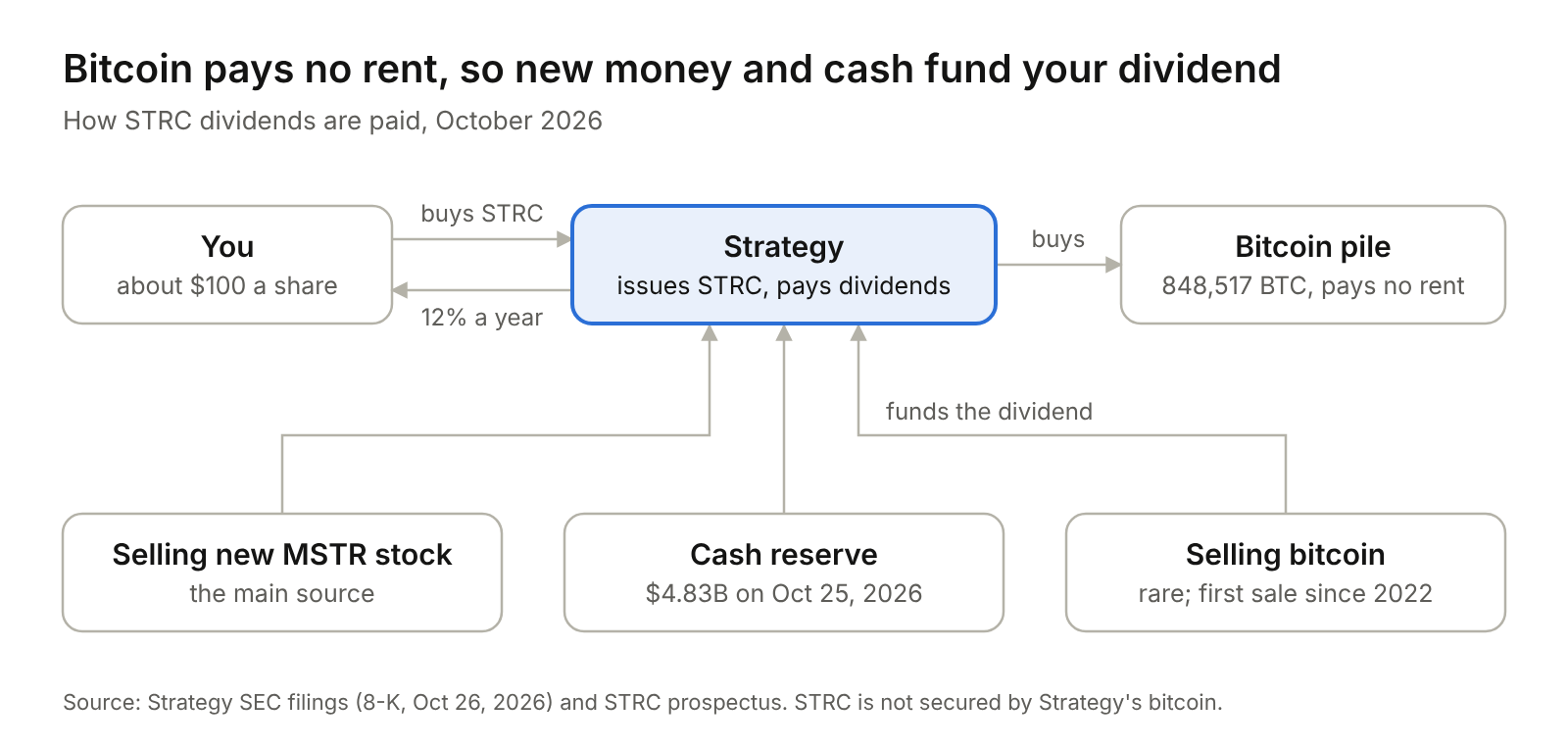
But critics are right about one thing: bitcoin produces no cash. Dividends are funded mostly by selling new stock and from the cash reserve. That works while Strategy can raise money, and the reserve exists for the stretch when it can’t. The YouTuber Coffeezilla made the opposite case loudly this year. We’d rather you understand the model than avoid the question.
Is STRC backed by bitcoin?
Not directly. STRC is not secured by Strategy’s bitcoin. It’s a claim on a company whose main asset is 848,517 bitcoin. That’s why we watch the 6.2x BTC Rating and the cash reserve, not a collateral agreement.
What happens if bitcoin crashes again?
We saw a version of it in June: bitcoin near $58,000, STRC in the low $70s, dividends still paid. A deeper or longer crash would push STRC’s price lower and put pressure on the dividend once the reserve shrinks. By Strategy’s math, bitcoin would need to fall below $13,336 before its bitcoin only matched STRC and everything ahead of it.
Why is Strategy rated junk?
S&P rates Strategy B-, below investment grade. That reflects a company concentrated in bitcoin without traditional operating cash flow. Strategy welcomed the rating anyway, saying it opens its securities to more investors. We want to see it climb as the reserve and the track record grow.
Will the 12% last?
No one can promise that. Strategy can cut the rate, though only by about 0.25 points a month. Saylor himself expects STRC’s extra yield over Treasuries to shrink over time. If the rate falls because the market trusts digital credit more, we’d count that as a win.
Is the tax benefit real?
For 2026, Strategy expects dividends to count as a return of capital. That lowers your cost basis instead of being taxed now, and you pay later when you sell. It depends on Strategy’s earnings each year and could change.
Is STRC a savings account?
No. It isn’t FDIC insured, its price can fall, and the board decides each dividend. Saylor compares it to a high-yield bank account, and we see why. It’s still an investment.
What about MSCI?
On October 15, the index provider MSCI adopted rules that could remove Strategy from its indexes after November 30. The final list is due November 11. Last year, JPMorgan estimated that an MSCI exclusion could mean about $2.8B of selling. That would hit MSTR, the stock Strategy sells to fund dividends. Strategy says the change wouldn’t meaningfully affect its business, and the reserve exists for exactly this kind of funding gap.
Why not just buy bitcoin?
They do different jobs. Bitcoin is for growth over years. STRC is for income while you hold. Saylor’s own pitch is that STRC belongs in the income part of a portfolio.
None of these answers make STRC risk-free. They make it understandable. That’s the bar we hold ourselves to.
What we’re watching, and why we’re building for it
The next five weeks will tell us a lot.
- October 28: Strategy holders vote on daily STRC dividends.
- November 1: If the vote passes, the first daily dividend. It falls on a Sunday, and Saylor wants weekends included.
- November 9: Strive’s SATS starts paying every business day.
- November 11 and 30: MSCI names the companies it will remove, then the removals take effect.
- Every Monday: Strategy’s weekly filing. We watch the reserve and the buybacks.
- Around the 1st of each month: The STRC rate for the month.
Coinage exists because we believe money should never be the bottleneck to human experience. For most people the bottleneck isn’t effort. It’s that their savings sit at 0.37% while the assets they believe in pay nothing. Digital credit is the first product we’ve seen that tackles both problems at once.
Saylor’s stack has a top layer: apps that bring digital money and yield to everyday people. That’s the layer we’re building.
Hamilton turned IOUs nobody trusted into capital a young country could build on. We think digital credit can do the same for bitcoin. We’re here for it.
Maxi, in Coinage
Pick one. Every dollar follows.
Maxi is a mode in Coinage. Pick one stock or fund, Stretch included. Money you add buys it. Your rules can too. Leave any time. Nothing is sold.
This post shares our views and research. It isn’t a recommendation to buy any security. STRC can lose value, and its dividend isn’t guaranteed. Stretch (STRC) is preferred stock issued by Strategy Inc.; its issuer sets the dividend rate every month, and rates can change. Investing involves risk, including possible loss of principal.
Sources
Grouped by the section they support. Figures are as of October 2026 unless noted.
Update, October 28
Why we’re writing this
Bitcoin: the base layer
- The Block: the 20 millionth bitcoin is mined
- Coinotag: spot bitcoin ETFs at 1,000 days
- BIT Academy: how IBIT became the fastest-growing ETF
- CoinStats: bitcoin treasury companies
- SpazioCrypto: corporate buying vs mining, citing Bitwise
- BlockchainReporter: bitcoin price, October 2026
- Cointelegraph: a brief history of bitcoin crashes and bear markets
An old idea in new clothes
How STRC works
Seven reasons we’re bullish
The stress test
- CoinDesk: how STRC lost its par
- CoinDesk: STRC hits a record low
- Crypto Briefing: Strategy’s plan to normalize STRC
- The Defiant: Phong Le buys 11,000 STRC shares
- The Block: the June 25 sell-off
- BitcoinWorld: Jeff Walton on the June slide
- Strategy: Digital Credit Capital Framework, June 29, 2026
- Strategy 8-K, August 31, 2026: reserve at $5.10B
- Strategy 8-K, October 19, 2026: STRC buybacks